
The Layered History of 150 Wentworth Street
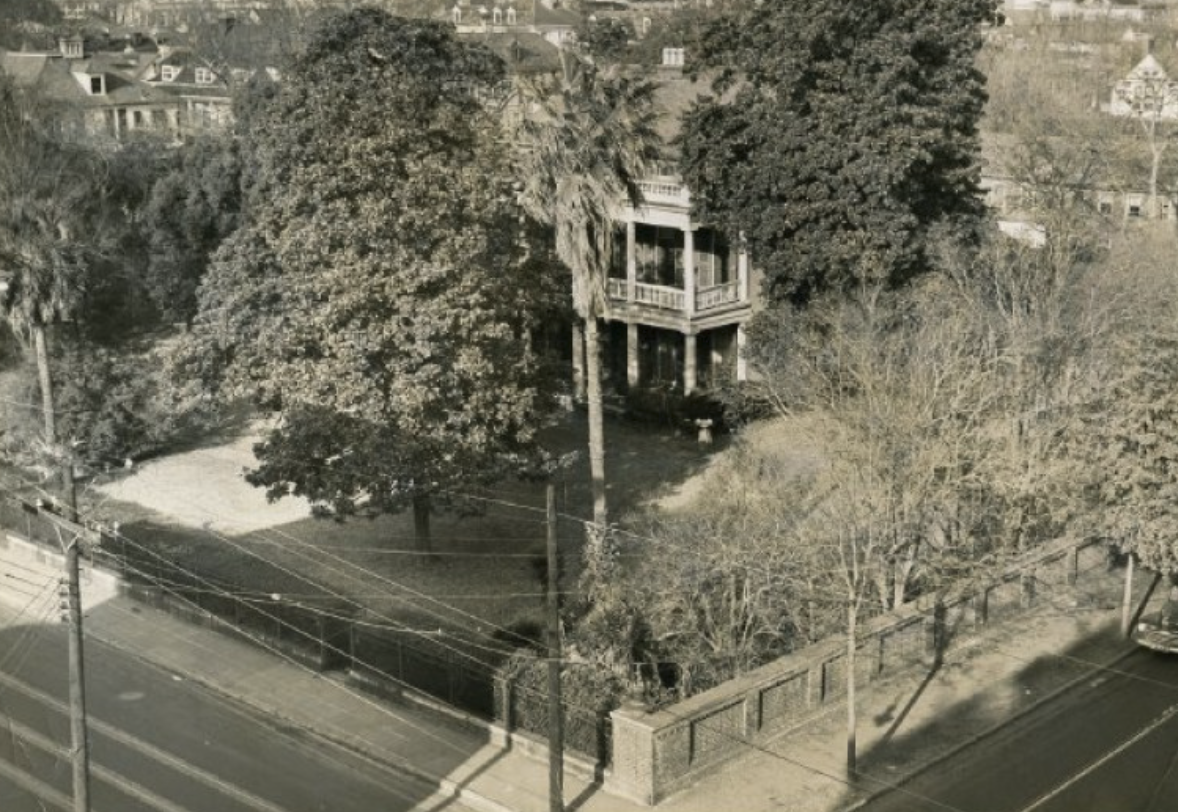
Memminger’s House, 1840–1865
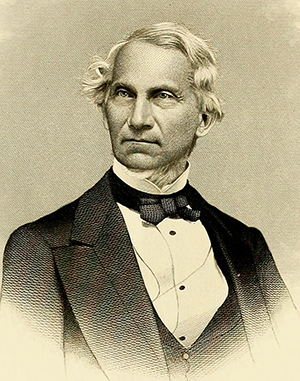
The house grew in stages. According to a 1936 newspaper account, Memminger built one section “more than 100 years ago and some twenty years later added the much larger section to the front of the original house.” Each was three stories, but at slightly different floor heights, requiring small interior stairways between them. The quirk gave the home its characteristic asymmetry. The grounds were just as distinguished, featuring specimen trees that included what was believed to be the largest crepe myrtle in the city and a “Himalayan pine of mighty proportions.”
After the War, 1865–1936
After the Civil War, federal authorities seized the property under the Bureau of Refugees, Freedmen, and Abandoned Lands. For roughly two years, the Confederate Treasury Secretary’s home served as an asylum for orphaned, formerly enslaved children: a striking inversion of its earlier symbolism. Memminger recovered title in 1867, and the property would remain in his family for nearly a century. After Memminger’s death, the property passed to his daughter Lucy and her husband, Charles Cotesworth Pinckney, and later to their daughter Randolph and her husband, Edward W. Hughes.
The Funeral Home Era, 1937–2014
That continuity broke in 1936, when the property passed out of the Hughes family through a bank-related transfer. The following year, McAlister Realty Company, a subsidiary of the McAlister Funeral Home, acquired the site and quietly began conducting funerals from it. The neighbors objected. Thirty-eight petitioned against commercial use; an adjoining owner sued; and in 1943 the South Carolina Supreme Court upheld an injunction. The McAlisters could live in the house, but they could not bury anyone from it.
That set a pattern. A 1949 proposal for a fourteen-story apartment tower on the site was defeated by local opposition. Then in 1956, the McAlister firm, represented by attorney Ernest F. Hollings (later U.S. Senator), successfully appealed to city council. The Memminger House was demolished. In its place rose a two-story funeral home designed by Charleston architect Augustus Edison Constantine, completed in 1960. McAlister-Smith eventually moved to the suburbs and sold the property in 2006.
Two more redevelopment proposals followed. A 2006 condominium plan was defeated by neighborhood opposition. So was a 2012 plan for a 32,000-square-foot, forty-two-room inn. The lot sat vacant. Vines covered the western façade. Windows showed water damage.
A Use the City Could Agree On, 2014–2018
A use finally took shape around 2014 with a proposal for a Fisher House: a residence for the families of veterans receiving care at the nearby Ralph H. Johnson VA Medical Center. Fisher House Charleston LLC acquired the site following a community-led campaign that raised more than $4 million for the project. After roughly sixty years of failed proposals, this one cleared the political bar. After decades of arguments about what should be built here for profit, someone had finally proposed building something here for service.
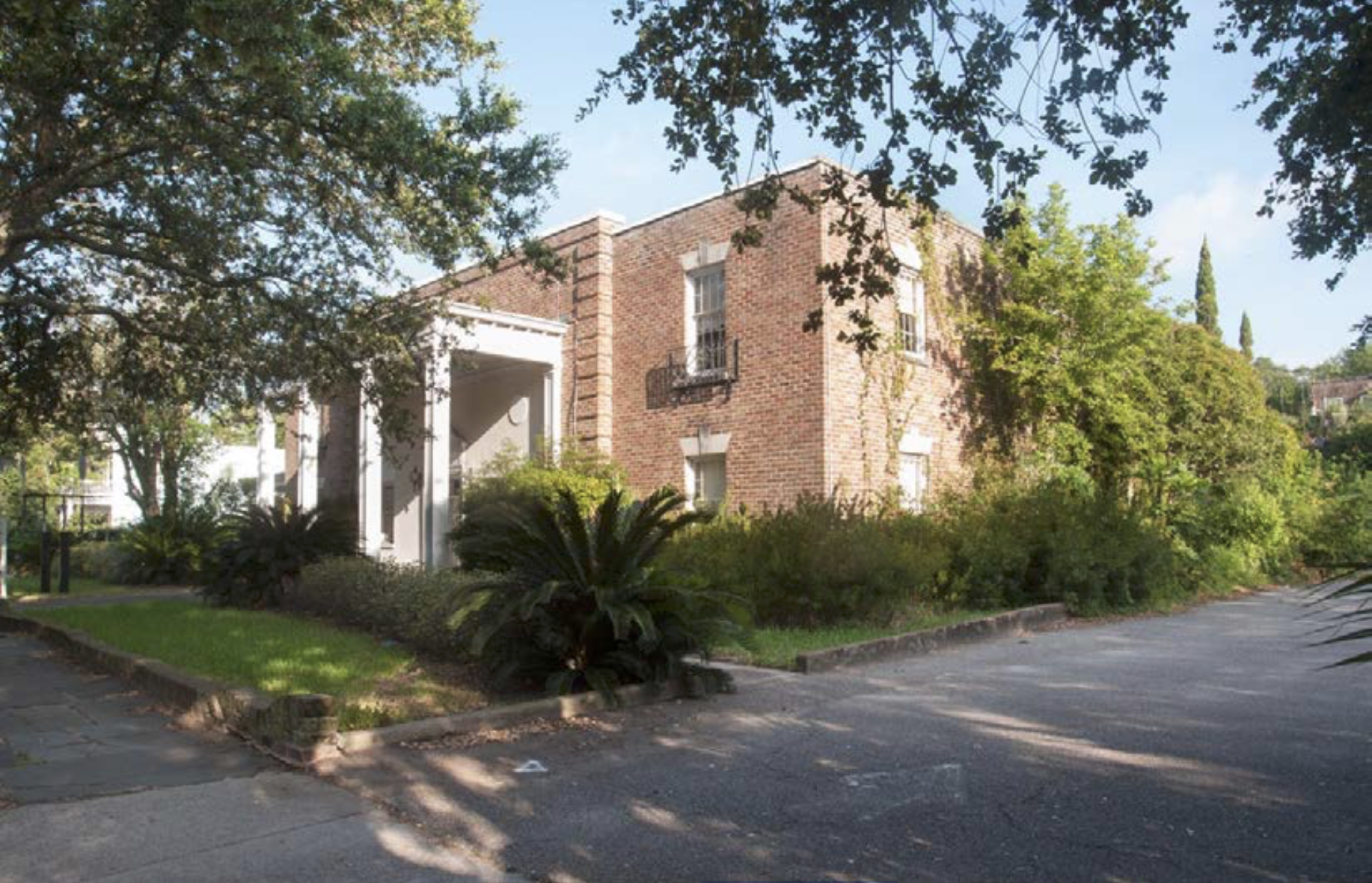
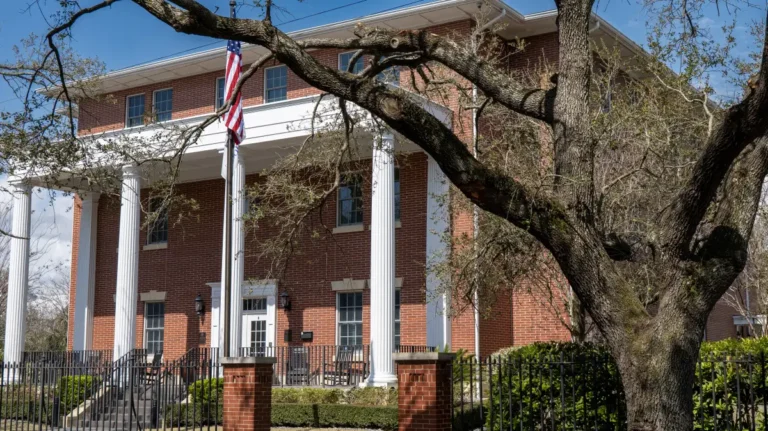 ThenNowTap to reveal
After decades of arguments about what should be built here for profit, someone had finally proposed building something here for service.
The historic district did not let the project move quickly. Before ground could be broken, the federal government required HABS Level II Documentation (Historic American Buildings Survey No. SC-885), completed in October 2016. The Constantine-era funeral home was demolished, but the mid-19th-century carriage house and the 186-foot brick wall along Smith Street, the only surviving fragments of the Memminger era, had to be fully preserved. In January 2018, the Charleston Fisher House officially opened its doors.
The House Today
Today the 15,000-square-foot home offers 16 private guest suites and shared kitchen, living, and dining spaces. Veteran families never pay for a single thing during their stay: lodging, linens, toiletries, snacks, everyday essentials. By July 2021, the House had welcomed its 2,500th veteran family.
The Carriage House
The carriage house deserves its own note. Built around 1850 to serve the Memminger property, it survived the Civil War, the 1886 Charleston Earthquake, more than a century of hurricanes, the 1956 demolition of the Memminger House right next to it, and the demolition of the funeral home that replaced it.
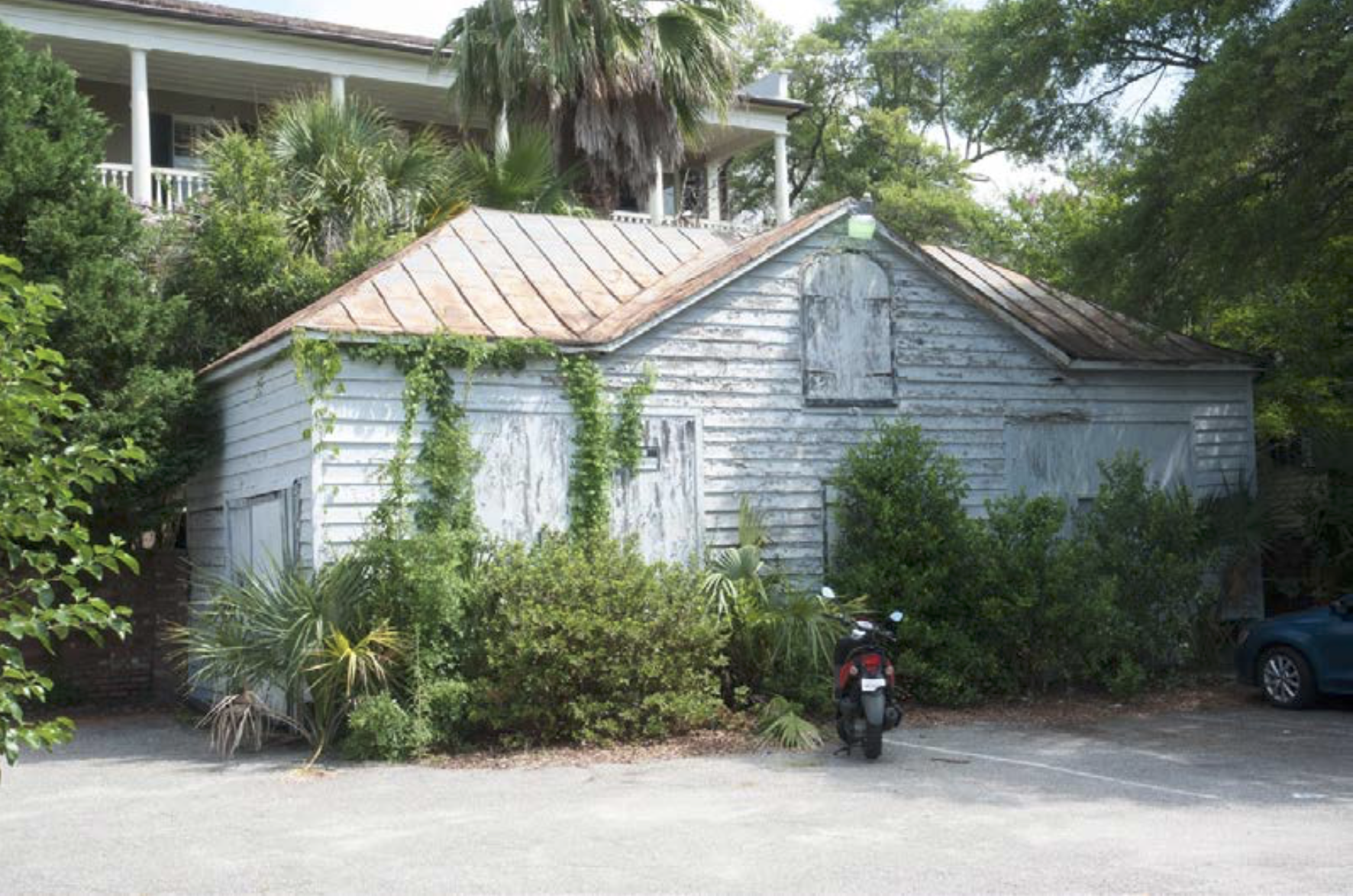
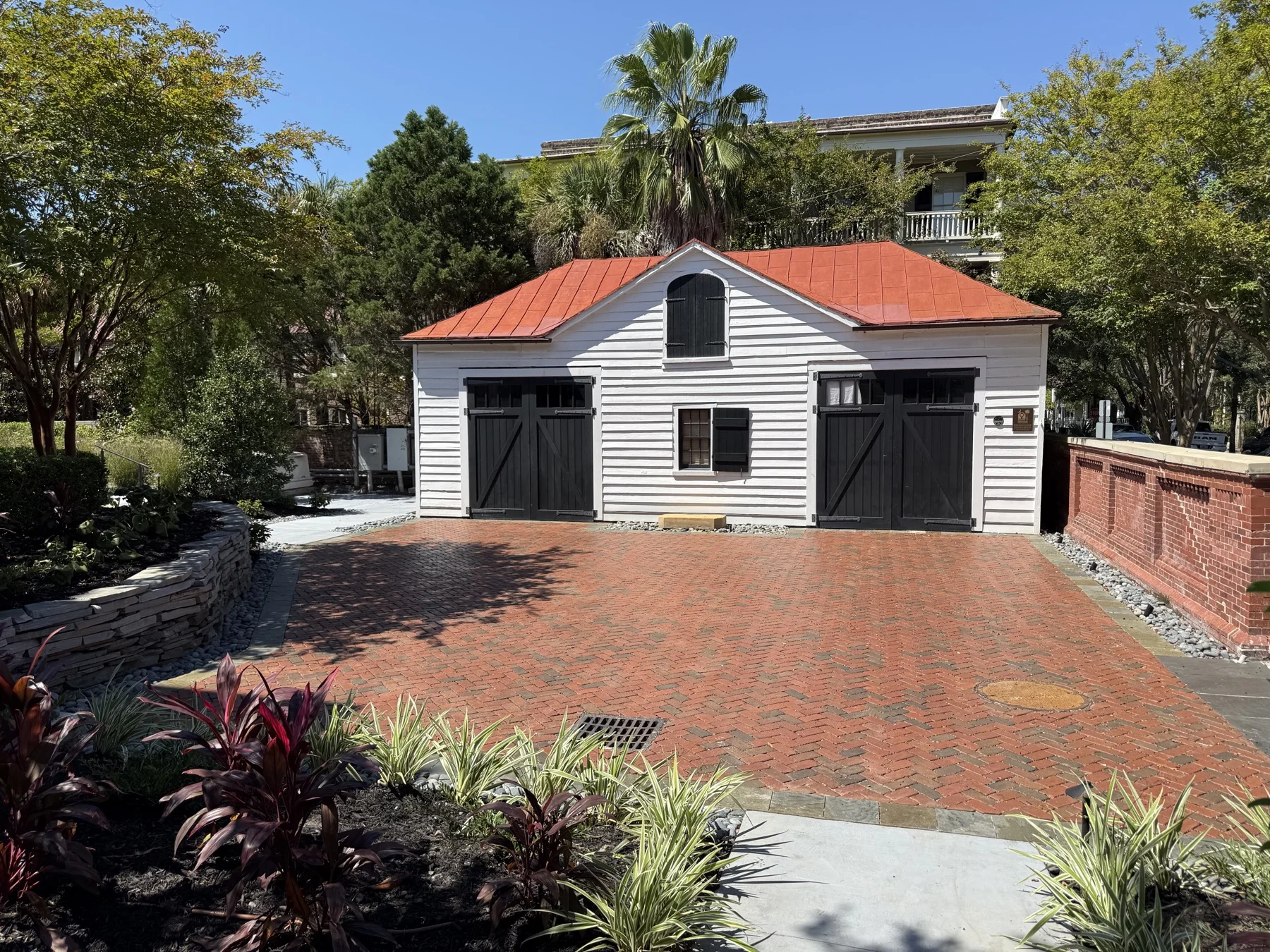 ThenNowTap to reveal
When Friends of Fisher House Charleston acquired the lot, the carriage house was in highly dilapidated condition, but as a contributing resource to the Charleston Old and Historic District, it could not be ignored. The community raised an additional $500,000 to stabilize and restore it. A more than two-year rehabilitation, coordinated with the Board of Architectural Review, was completed in 2020. The restored carriage house later received a 2021 Exterior Carolopolis Award from the Preservation Society of Charleston.
Unlike many historic carriage houses downtown that have been converted into vacation rentals, this one was deliberately kept in service. It holds extra linens for the suites, toiletries and everyday essentials, pantry overflow, and donations from the Charleston community: the operational backbone of the House’s hospitality.
A 2025 grounds improvement project extended that same restoration ethic to the landscape immediately around the carriage house and along the historic Smith Street brick wall. Refreshed plantings sympathetic to the historic district, improved drainage and ground surfaces, welcoming pedestrian paths, and lighting appropriate to the building’s mid-19th-century character transformed a utilitarian service zone into a quiet, restful complement to the main residence. For families in the middle of a medical crisis, another outdoor space to step away to, for a phone call, a few minutes of fresh air, a moment of green, matters as much as the indoor ones.
Step back from the names and dates, and the threads tie together. The lot has always attracted figures of outsized civic weight. Three major redevelopment fights were defeated by organized neighbors before a fourth finally succeeded: not for profit, but for service. And what stands here today completes the inversion that began in 1865. A house once built by the Confederate Treasury Secretary, then briefly an orphanage for freed children, then a contested funeral home, is now a place where America’s veteran families are welcomed, sheltered, and asked to pay nothing.
That is a story worth standing for.